
The Student Who Made $1 Million Selling Pixels on a Webpage

Imagine pitching this startup idea in 2005:
Build a mostly empty webpage. Divide it into one million tiny pixels. Sell each pixel for $1.
No sophisticated software. No subscription. No marketplace. No AI. No revolutionary technology.
Just pixels.
It sounds more like an internet joke than a business. But 21-year-old British student Alex Tew tried it anyway.
A little over four months later, every pixel was gone.
The website had generated $1,037,100 in gross sales.
And almost twenty years later, The Million Dollar Homepage is still online—a chaotic digital time capsule from an era when an absurdly simple idea could suddenly spread across the entire internet.
It Started With a Much Smaller Problem
Tew wasn’t originally trying to create the next major internet company.
In August 2005, he was preparing to study business management at the University of Nottingham and was thinking about something far less glamorous: how to pay for university without ending up heavily in debt.
One night, he started brainstorming ways to make money.
The idea needed to be simple. It needed to be cheap enough for him to build himself. And ideally, it needed to be interesting enough for people to talk about.
Eventually he landed on a strangely mathematical business model:
1,000,000 pixels × $1 = $1,000,000.
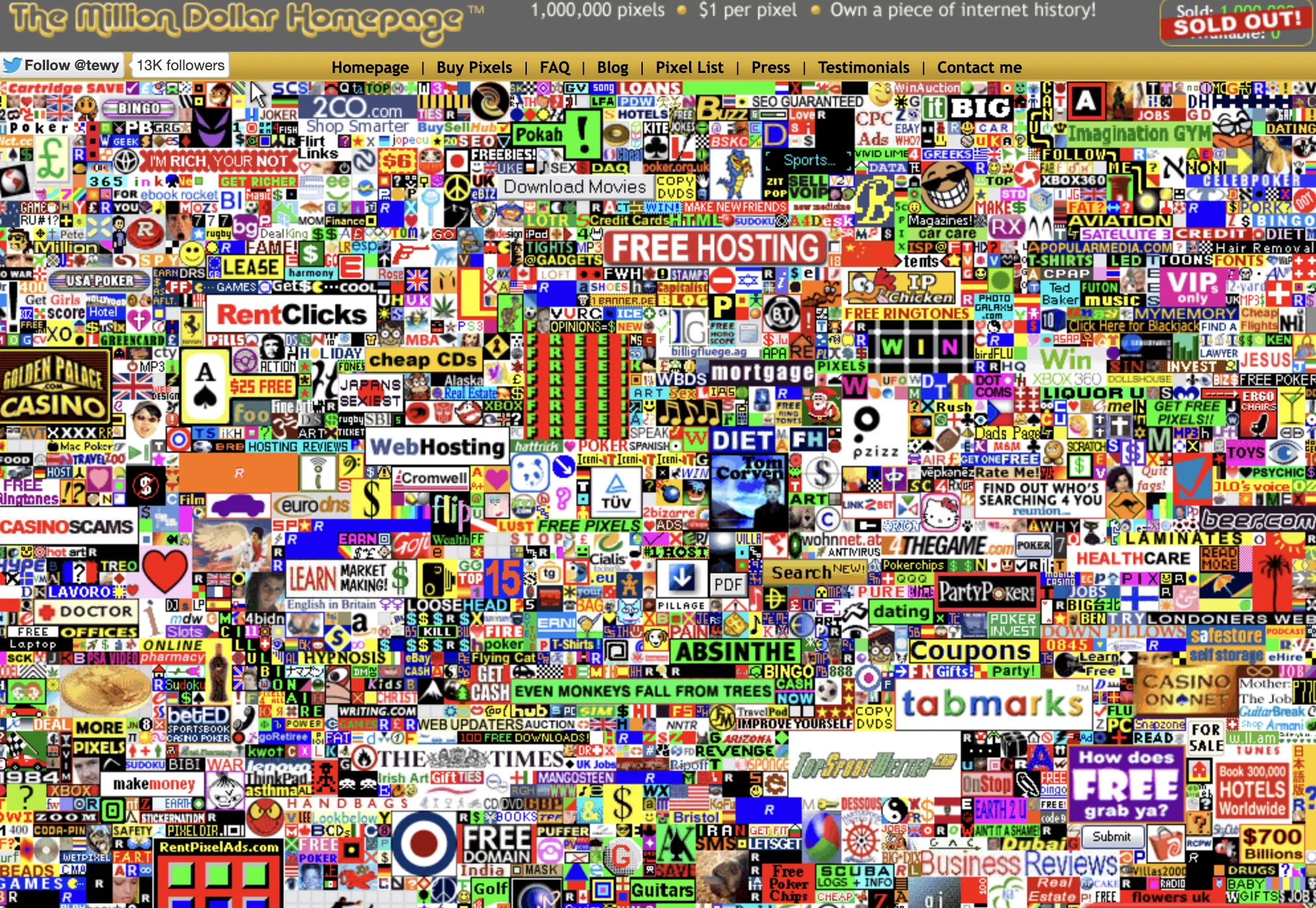
He created a 1,000 × 1,000-pixel grid and offered pieces of it to advertisers.
There was one practical problem. A single pixel is almost invisible, so advertisers couldn’t actually buy just one. Space was sold in blocks of at least 100 pixels, making the minimum purchase $100.
A buyer could provide a tiny image or logo, a website URL and some text. Visitors clicking the image would be taken to the advertiser’s website.
That was essentially the entire product.
The First Pixels Were the Hardest
Of course, an empty advertising page has a serious chicken-and-egg problem.
Why would anyone advertise on a website nobody visits?
Tew started with people he knew.
His first customer was a friend who bought 400 pixels. Friends and family helped fill some of the early space.
This mattered more than it might seem.
Imagine opening the site when it was completely empty. It would look like an unfinished project.
But once several businesses had already paid to appear there, something changed. New visitors could see that people were actually participating.
Tew then began pushing the story rather than simply pushing the advertising product.
After making his first $1,000, he sent out a press release. The unusual idea started attracting media coverage, including attention from the BBC and technology publications.
And this created the loop that would eventually make the project explode:
Media coverage brought visitors.
Visitors made the advertising more valuable.
More advertisers bought pixels.
More sales made the story even more interesting to the media.
The business was starting to market itself.
By late December 2005, Tew was approaching the $1 million target. The Guardian reported at the time that advertisers ranging from small online businesses to larger companies had purchased space, while hundreds of imitation pixel-selling websites had already appeared.
He Wasn’t Really Selling Pixels
This is probably the most important part of the story.
Technically, advertisers were buying pixels.
But pixels weren’t what made them valuable.
Anyone could create a webpage with a million pixels. In fact, many people did exactly that after seeing Tew’s success.
What they couldn’t easily recreate was the attention surrounding the original.
The Million Dollar Homepage became interesting because people wanted to see whether someone could actually sell all one million pixels.
Every sale moved the experiment closer to its ridiculous conclusion.
Visitors weren’t necessarily coming because they needed something from the advertisers. They were coming to look at the strange webpage everyone was talking about.
And advertisers wanted to appear on the page because those visitors were there.
It became a self-reinforcing spectacle.
Years later, Tew described the effect particularly well: people couldn’t believe he was making money from something so simple, and the fact that people kept talking about that absurdity was precisely what made the idea work.
In other words, the outrageous business model wasn’t a weakness.
It was the marketing strategy.
Then Scarcity Took Over
There was another clever constraint built into the project.
There could only ever be one million pixels.
Tew could easily have created another page once the first one filled up. That might have generated more revenue in the short term.
But doing that would have destroyed much of the idea.
The closer the counter moved toward one million, the more valuable the remaining space became.
Eventually, only 1,000 pixels remained.
Instead of selling them normally for $1,000, Tew put the final block on eBay.
The auction ended on January 11, 2006.
The winning bid?
$38,100.
That pushed the project’s total gross revenue to $1,037,100.
From the website’s August 2005 launch to the final sale, only 138 days had passed.
A student had effectively turned a blank HTML page into more than one million dollars in sales in less than five months.
Success Even Created a Very 2000s Internet Problem
The story didn’t end peacefully after the final auction.
Around the time the last pixels were being sold, attackers threatened Tew with a distributed denial-of-service attack unless he paid them money.
He refused.
The site was subsequently knocked offline, leading to involvement from law enforcement and a security company that helped bring the website back online.
According to contemporary reporting, the attackers demanded as much as $50,000.
It was a strange final chapter for a website that had begun as a student’s attempt to avoid university debt.
The little experiment had become valuable enough that criminals wanted a piece of it too.
The Copycats Proved Something Important
Once The Million Dollar Homepage became famous, clones appeared everywhere.
The formula looked almost embarrassingly easy to reproduce.
Buy a domain.
Create a grid.
Sell pixels.
Become a millionaire.
Except almost nobody repeated Tew’s result.
That tells us something important about startups built around novelty.
The code wasn’t the moat. The idea wasn’t even much of a moat. Timing was the moat.
The first Million Dollar Homepage was news.
The hundredth version was just another website selling tiny advertisements.
Tew understood this himself and resisted simply creating an identical second page.
This is why copying the visible mechanics of a successful startup often doesn’t reproduce the success. Sometimes the product only worked because it arrived at exactly the right cultural moment.
Could the Million Dollar Homepage Work Today?
Probably not in its original form.
Launching MillionDollarHomepage2.com in 2026 and charging $1 per pixel would almost certainly fail.
But the mechanism behind it still works constantly.
Think about limited NFT collections during their peak.
One-of-one digital items.
Lifetime software deals with limited quantities.
Viral Kickstarter campaigns.
Limited edition products.
Domains and usernames.
Even meme coins.
The underlying psychology is surprisingly similar.
People aren’t always buying something because of its practical utility.
Sometimes they’re buying scarcity, status, curiosity, participation or a place inside a story that other people are watching.
The Million Dollar Homepage combined almost all of those things.
And Alex Tew Didn’t Disappear
Perhaps the most interesting footnote is what happened to the student behind the experiment.
Tew ultimately didn’t need the business degree that originally motivated the project. He went on to experiment with several other internet businesses.
Not every project became another Million Dollar Homepage.
That’s another useful detail often removed from simplified startup success stories: even someone who creates a spectacular viral hit doesn’t automatically discover a repeatable formula for creating viral hits.
But Tew eventually built something much more durable.
In 2012, he co-founded Calm, the meditation and sleep app, with Michael Acton Smith. Calm still identifies Tew as one of its co-founders.
So the Million Dollar Homepage wasn’t simply the strange thing one lucky student did before disappearing from the technology world.
It was the beginning of a much longer entrepreneurial career.
The Real Lesson Isn’t “Sell Pixels”
There is an easy—but wrong—lesson to take from this story:
Find something ridiculously cheap, divide it into pieces and sell those pieces for a lot of money.
That’s not what made The Million Dollar Homepage work.
Its real product was a story people could understand in seconds:
A student is trying to make $1 million by selling one million pixels for $1 each.
You don’t need a technical explanation.
You don’t need an investor pitch deck.
You immediately want to know one thing:
Will people actually buy all of them?
That curiosity attracted attention. Attention attracted advertisers. Advertisers moved the counter upward. The rising counter created scarcity. Scarcity generated even more attention.
It was less like building a traditional advertising company and more like designing an internet experiment where the experiment itself generated the demand.
Twenty years later, the original website looks almost ridiculous: hundreds of tiny logos squeezed together into one colourful, barely readable wall.
Many of the websites behind those advertisements have disappeared. A later analysis found significant link rot across the page as the old internet slowly vanished around it.
Yet the homepage itself remains.
And that’s what makes this one of the strangest startup stories of the early internet.
Alex Tew didn’t invent a new technology.
He didn’t raise millions from venture capitalists.
He didn’t build a huge team.
He took something almost worthless—a blank webpage containing one million pixels—and gave people a reason to believe that owning a tiny piece of it was worth money.
Then the internet did the rest.
Start the discussion